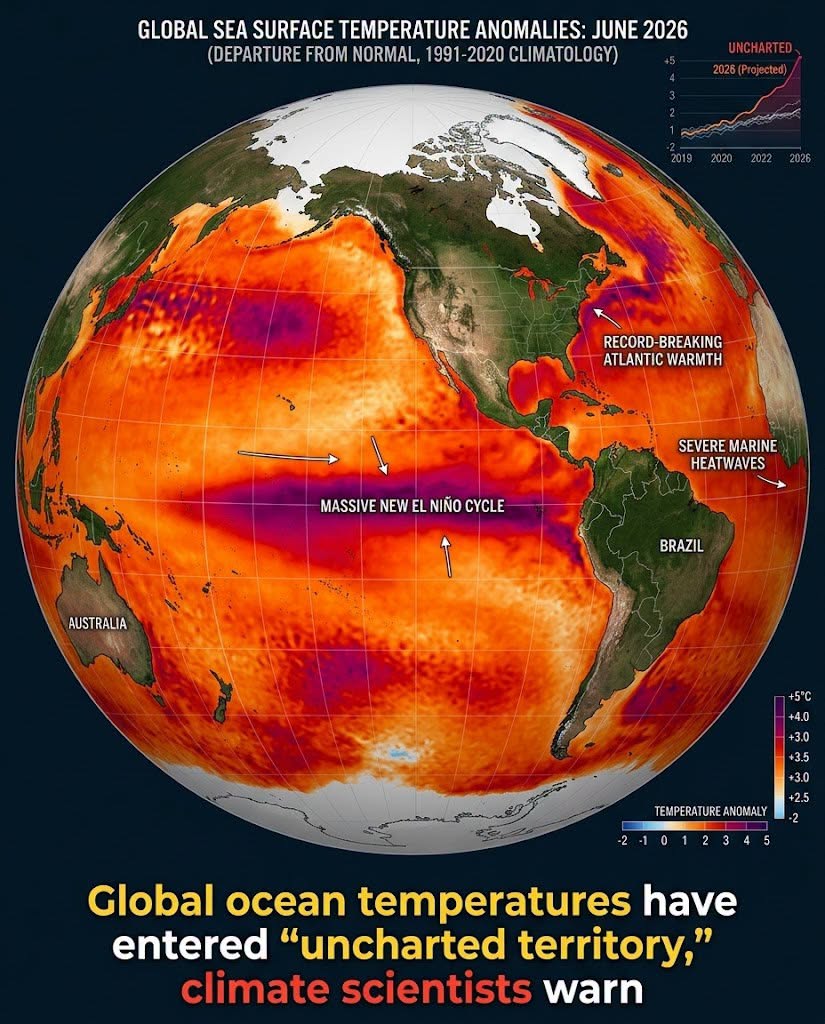
Did you know that nearly 40% of the global ocean is currently experiencing a marine heatwave? Parts of the Pacific Ocean and the Mediterranean Sea are running more than 10°F (5.6°C) above normal. To top it off, the Copernicus Climate Change Service reported that we recently saw the hottest June ever recorded for the world’s oceans. 

Why does this matter to us? 
The ocean and atmosphere are constantly exchanging heat and moisture. Our oceans are the unsung heroes of climate change, absorbing more than 90% of the excess heat trapped by greenhouse gases. But this enormous reservoir of energy comes with consequences: Supercharged Heatwaves: When unusually warm water reaches the surface, heat moves back into the atmosphere. Research suggests that at least 1 in 5 heatwaves on land begins with unusually warm conditions in the ocean. Extra-warm waters are actively contributing to oppressive heat and humidity from Europe to the United States.
 Heavier Downpours & Flooding: For every 1.8°F (1°C) of warming, our atmosphere can hold about 7% more moisture. While it doesn’t mean it rains constantly, it does mean moisture builds up for longer, drastically increasing the risk of extreme downpours and flash flooding when storms finally break.
 Stronger Storms: Warmer seas supply tropical cyclones with extra heat and moisture—essentially acting as storm fuel. Combined with sea-level rise caused by the thermal expansion of warm water, storm surges are able to travel much further inland.